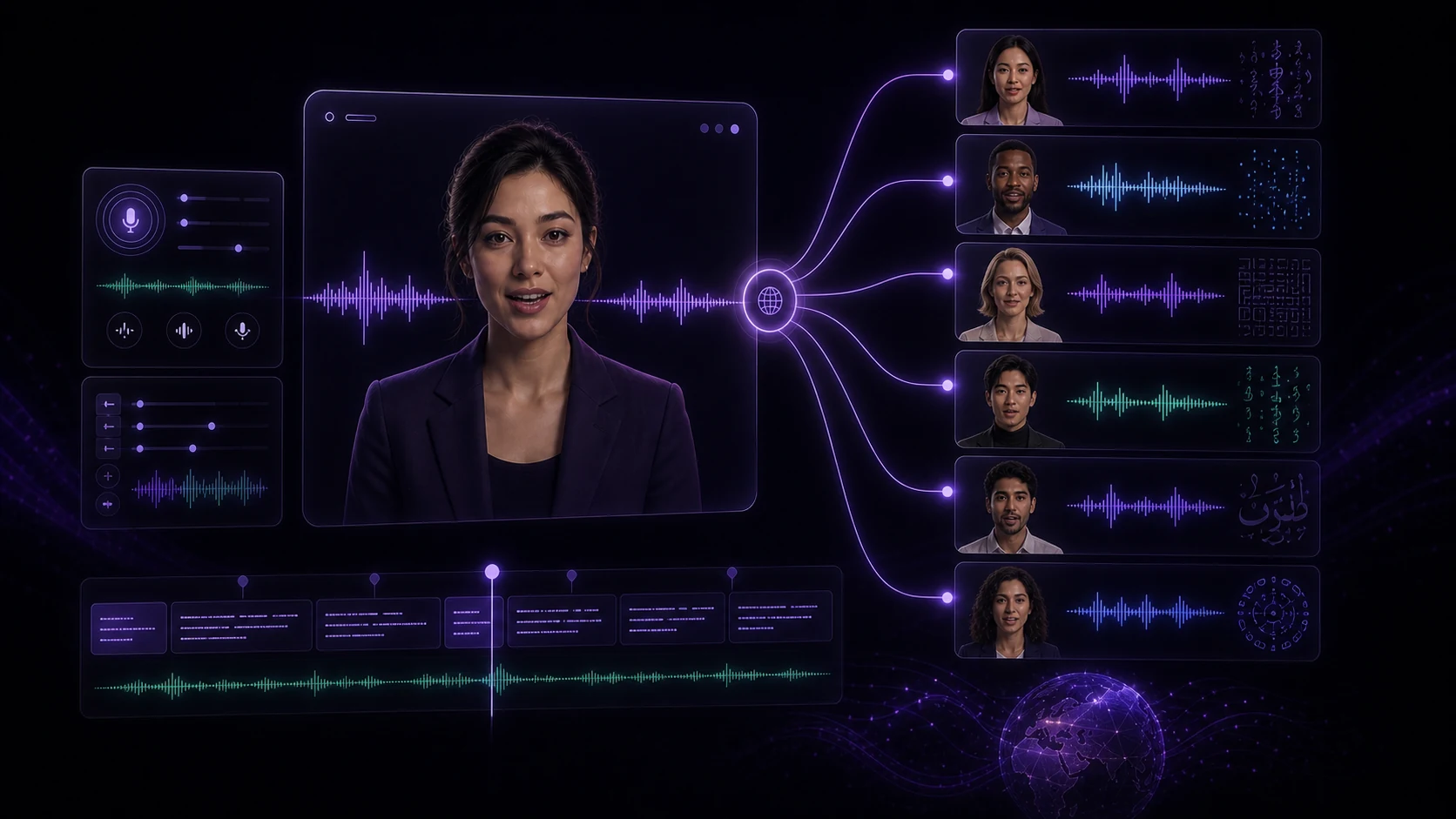
Localizing content into multiple languages used to mean hiring translators, booking voice actors for each language, and managing separate production pipelines. AI voice technology has compressed that workflow significantly — you can now produce localized audio in dozens of languages from a single script, with voice quality that works for professional use cases.
That said, multilingual AI voice production has its own set of decisions and pitfalls. This guide walks through the process from language selection to cultural adaptation.
Part 1: Language Selection and Voice Quality
Not all languages are equally well-served by current TTS technology. Choosing a tool with strong support for your target languages upfront prevents quality surprises later.
Tier 1 languages (mature TTS, many voice options, high naturalness):
- English (US, UK, AU, CA variants)
- Spanish (Latin American, Castilian variants)
- French (France, Canadian variants)
- German
- Portuguese (Brazilian, European variants)
- Japanese
- Chinese (Mandarin Simplified, Traditional)
Tier 2 languages (good quality, fewer voice options):
- Italian, Dutch, Korean, Arabic, Hindi, Russian, Polish
Tier 3 languages (functional but limited voice options):
- Many smaller market languages — check your specific tool's voice library
When selecting voices for non-English languages, prioritize voices trained on native speaker data rather than accented English voices. The difference in naturalness is significant, particularly for phoneme-heavy languages like Arabic or tonal languages like Mandarin.
VidReels supports 40+ languages with native-quality voices in major markets. Preview voices with a short segment of your actual translated script before committing to a voice for a full production.
Part 2: Accent Considerations
Accent choice matters more in some markets than others. For some languages, any regional accent is broadly acceptable; for others, the wrong accent signals that the content wasn't made for that audience.
High-sensitivity accent markets:
- Spanish — Latin American (neutral) vs. Castilian Spanish are perceived very differently. Mexican Spanish, Colombian Spanish, and Argentinian Spanish each have distinct markets.
- Portuguese — Brazilian and European Portuguese are mutually intelligible but feel culturally distinct. Brazilian content for European audiences (or vice versa) can feel off.
- French — Parisian French is standard for international audiences; Canadian French serves Canadian-specific audiences.
- English — General American is the most internationally neutral; British (RP) has different connotations in different markets.
- Arabic — Modern Standard Arabic is broadly understood but can feel formal; Egyptian Arabic is widely understood as a regional neutral.
Lower-sensitivity accent markets:
- Most European languages (German, Italian, Dutch) have less dramatic regional variation in TTS voice sets.
Use native speaker review for any language you're not personally fluent in. TTS occasionally produces mispronunciations of proper nouns, brand names, or idiomatic phrases. A 5-minute native speaker listen-through before publishing can catch errors that would be embarrassing at scale.
Part 3: Code-Switching
Code-switching — mixing languages within a single audio segment — is common in multilingual markets and communities. AI TTS handles it with varying degrees of grace.
Common code-switching scenarios:
- Product names or technical terms in English within a non-English voiceover
- Proper nouns (person names, place names) from one language within another
- Phrases like "as we say in English..." followed by an English phrase
Practical handling:
- Most TTS engines can be forced to use language-specific pronunciation rules for marked sections using SSML
- For product names or brand terms, add them to the pronunciation dictionary with phonetic spellings in each language
- If code-switching is frequent, test the transitions — some voice models handle language switching better than others
<!-- SSML for English term within Spanish narration -->
<speak xml:lang="es-US">
  Configuramos el
  <lang xml:lang="en-US">dashboard</lang>
  para mostrar métricas en tiempo real.
</speak>
Part 4: Subtitle Pairing
Subtitles are essential for multilingual video content — both for accessibility and because video is frequently watched without audio in public settings.
Subtitle best practices for multilingual content:
- Sync to the TTS timing — AI-generated audio has consistent, predictable timing, which makes auto-subtitle generation from the script more accurate than with human speech
- Character limits per line — 42 characters per line maximum; 2 lines maximum visible at once
- Duration per subtitle card — match the TTS speech rate; fast speech needs fewer characters per card
- Language-specific considerations — some languages (German, Finnish) have longer words; CJK languages (Chinese, Japanese, Korean) read faster per character
VidReels can generate time-synced subtitle files (SRT, VTT) from TTS-generated audio, which simplifies the subtitle workflow significantly.
Subtitle file formats:
- .SRT — universal, supported by every platform
- .VTT — WebVTT for web video (HTML5 players)
- .ASS/.SSA — advanced subtitle format for rich styling (used in Anime localization and some broadcast contexts)
Part 5: Cultural Adaptation
Translation and localization are not the same thing. A direct translation of your English script may be grammatically correct in the target language but culturally tone-deaf.
Cultural adaptation checklist:
- Idioms and metaphors — translate the meaning, not the words. "Hit it out of the park" doesn't land in markets where baseball isn't familiar.
- Humor — jokes are highly culture-specific. A pun in English is usually untranslatable. Replace humor with locally resonant equivalents or remove it.
- References — celebrity names, cultural references, and historical events mean different things in different markets. Localize or remove.
- Formality level — some languages (German, French, Japanese) have formal and informal registers that carry social weight. Match your formality to your audience relationship.
- Date and number formats — "06/07/2026" means June 7 in the US and July 6 in much of Europe. Spell out months in multilingual content.
Conclusion
Multilingual AI voice production is genuinely viable in 2026 — but it rewards users who treat localization as a content decision, not just a technical one. Choose high-quality voices for your target languages, validate accent fit with your specific markets, handle code-switching carefully, sync subtitles to your TTS audio, and adapt culturally rather than just translating literally. VidReels' multilingual TTS capabilities give you the production infrastructure; the cultural intelligence still needs to come from people who know the markets.